
The 2026 AI SEO & GEO Blueprint: Engineering Dominance in the Era of Answer Engines AI Growth & Search Dominance
Master AI SEO and GEO strategies for 2026. Learn entity alignment, citation share engineering, and why AI traffic is 4.4x more valuable than traditional
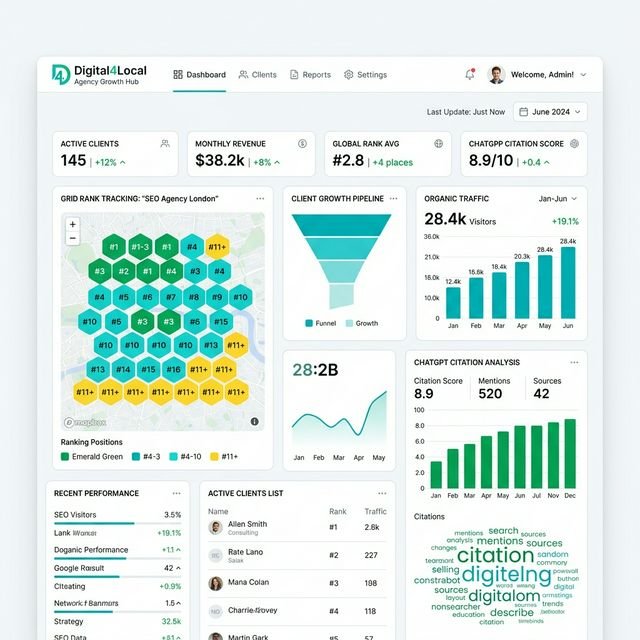
Table of Contents
- The Death of the Blue Link: Why AI SEO is the 2026 Standard
- Core Terminology: Defining the GEO Landscape
- The Economics of AI Search: Why GEO Traffic is More Valuable
- Entity Alignment: The Step-by-Step Roadmap to AI Authority
- Engineering Citation Share in AI Overviews
- Local SEO + AI: Dominating the Local Grid
- Technical AEO Audits: Making Your Site Machine-Readable
- AI SEO for Startups and SaaS: Scaling Organic Growth
- The Digital4Local Performance Framework
- Common Pitfalls: Why Traditional SEO Agencies Fail at GEO
- Key Takeaways: Your AI SEO Strategy for 2026
- Start Your AI Growth Sprint: The 2026 Strategy
The Death of the Blue Link: Why AI SEO is the 2026 Standard
Sixty percent of searches now end without a click, as AIOSEO's search data shows, because AI Overviews answer the question before a user ever reaches a website. That single number reorders every assumption built into a decade of SEO retainers. Ranking positions still exist. The traffic that used to follow them does not.
60% of searches end without a click. Organic CTR on queries with Google AI Overviews fell by 61% between June 2024 and September 2025, according to Ahrefs.
The blue link era rewarded a simple mechanic: match a string, earn a position, collect a click. Answer engines work differently. Gemini, Perplexity, and ChatGPT do not hand a user ten documents and let them sort it out — they read across sources, resolve which entities are credible, and synthesize a single response with a handful of citations attached. Indexing was a filing problem. Synthesis is a trust problem. The question is no longer whether a page can be found, but whether a model considers your brand a reliable thing to name.
This is the argument the rest of this guide defends: visibility in 2026 is won at the entity layer, not the keyword layer, and the brands that formalize their identity in machine-readable terms will absorb the citation share that legacy SEO firms are still trying to convert into pageviews. A keyword is a string of characters. An entity is a disambiguated, verifiable node that a knowledge graph can reason about — and generative systems cite entities.
Digital4Local operates as a performance-first AI SEO company built around that distinction. The deliverable is not a ranking report. It is measurable presence inside the answers your buyers actually read, and the inbound calls that follow from it.
Core Terminology: Defining the GEO Landscape
Before the technical work makes sense, the vocabulary has to be precise. These four terms carry the weight of the entire framework, and they are routinely used interchangeably by people who should know better.
Generative Engine Optimization (GEO)
The practice of structuring content, data, and brand identity so that generative AI systems select and cite your source when composing an answer.
Answer Engine Optimization (AEO)
A narrower discipline focused on conversational, direct-response queries — formatting information so a machine can extract a clean, self-contained answer without ambiguity.
Entity Authority
The degree to which a brand exists as a resolved, trusted node in a knowledge graph rather than as a loose collection of keyword matches scattered across the web.
Citation Share
The proportion of AI-generated responses within a defined query set that name, link, or quote your brand — the generative equivalent of share of voice.
The relationship between these four matters more than any individual definition. Entity Authority is the foundation: a model cannot cite what it cannot confidently identify. AEO is the content-level execution layer that makes individual passages extractable. GEO is the strategy that coordinates both across every surface where answers are generated. Citation Share is the scoreboard.
Legacy reporting measures positions, impressions, and sessions. None of those survive contact with an interface that returns one synthesized paragraph. A Generative Engine Optimization agency inverts the model entirely: it works backward from the answers being generated today, identifies which entities the models already trust in your category, and closes the gap between where your brand sits in that graph and where it needs to sit.
The Economics of AI Search: Why GEO Traffic is More Valuable
Value: Fewer Visitors, Better Visitors
A user who arrives from an AI answer has already had their research question resolved. They are not comparing ten tabs; they are acting on a recommendation. That selection effect shows up in the numbers — Semrush reports that the average AI search visitor is worth 4.4x more than a traditional organic search visitor. The implication for budgeting is direct: a drop in raw session volume is not automatically a drop in revenue, and judging GEO by traffic charts will lead you to defund the channel that is converting.
Investment: The Infrastructure Is Permanent
Some channels are fashions. This one is capitalized. Generative AI funding reached $25.2 billion in 2023, according to the Stanford Institute for Human-Centered AI — infrastructure spending at that scale does not get unwound because marketers find it inconvenient. The interfaces consuming your content today are the beginning of the deployment curve, not a pilot phase. Planning a 2026 acquisition strategy around a return to ten blue links is planning against the balance sheets of the companies building the replacement.
Efficiency: Models Are Getting More Trustworthy
Reliability improvements matter to publishers because they govern how willingly users delegate decisions to the machine. OpenAI research found that GPT-4 showed an 82% reduction in disallowed content responses compared to GPT-3.5, making it a more dependable tool for the people using it. As confidence rises, more of the decision-making journey happens inside the answer layer — and the brands cited there inherit the decision. This is where AI-powered SEO services earn their keep: optimizing for the system that makes the recommendation rather than the page that hopes to receive the click.
Entity Alignment: The Step-by-Step Roadmap to AI Authority
Entity alignment is the process of making your brand unambiguous to a machine. Models disambiguate by cross-referencing structured sources; if your identity is inconsistent across those sources, you are a fuzzy match rather than a confident citation. Here is the sequence, and the order is not arbitrary — each step supplies the evidence the next one depends on.
- Establish the canonical record. Wikidata functions as a backbone reference for knowledge graphs. A properly constructed item — with industry classification, founding details, official website, and headquarters location — gives downstream systems a stable identifier to resolve against. Address notability honestly: items require independent, verifiable references, so build the citation trail before the item, not after.
- Publish Organization schema as the hub. Your site should carry a single authoritative Organization node, referenced by @id from every other schema object on the domain. This is the technical act of saying "all of these pages describe the same thing."
- Link disparate profiles semantically. The sameAs property is the connective tissue. Point it at LinkedIn, Crunchbase, your Google Business Profile, industry directories, and the Wikidata item. Each link is a corroborating vote that collapses scattered mentions into one entity.
- Enforce identity consistency. Legal name, address, founding year, and executive names must match character for character across every surface. Variance introduces doubt, and doubt costs citations.
Technical callout — JSON-LD formatting. Place the Organization block in a <script type="application/ld+json"> tag in the <head>, assign it a persistent @id such as https://example.com/#organization, and reference that @id from WebSite, LocalBusiness, and Article nodes. Never duplicate the organization definition on multiple pages — reference it. Duplication creates competing entities; referencing reinforces one.
Engineering Citation Share in AI Overviews
Citation Share is the metric that replaces average position. It answers a single question: across the set of queries that matter to your business, what percentage of generated answers name you? It is measurable, it is competitive, and unlike rankings it maps directly to whether a prospect encounters your brand during the moment of decision.
The case for the pivot is in the CTR data. The PEAIO visibility loss ratio shows a 34.74% decline in organic CTR for top-10 positions due to AI Overviews. Holding a top-10 position is no longer the same asset it was — which makes the position itself an increasingly poor proxy for commercial visibility.
| Metric | Traditional SEO | AI SEO / GEO |
|---|---|---|
| Primary unit | Keyword position | Citation Share |
| Target object | URL | Entity |
| Visibility surface | SERP listing | Synthesized answer |
| Measurement cadence | Weekly rank snapshot | Continuous prompt sampling |
| Competitive frame | Who ranks above me | Who gets named instead of me |
| Content goal | Match query intent | Supply quotable, verifiable claims |
Benchmarking requires running representative prompt sets across Perplexity, Gemini, and ChatGPT on a schedule and recording which domains get cited, how often, and in what position within the response. That produces a competitive map no rank tracker can generate. Becoming the top recommended option is then a supply problem: models favor sources that state specific, attributable claims in extractable form — defined comparisons, named criteria, clear pricing logic, dated data.
If you cannot report what percentage of AI answers in your category name your brand, you are not measuring your actual visibility. A GEO SEO agency should be delivering that figure as a standing line item.
Local SEO + AI: Dominating the Local Grid
The Local Grid
Generative engines do not invent local data. They pull it from Google Maps, Yelp, and structured business listings, then rephrase it conversationally. That makes your Google Business Profile a primary training surface, not a secondary directory listing. Grid tracking — measuring rank across a geographic mesh of coordinates rather than at a single city center — exposes where your visibility collapses block by block, which is precisely the resolution an AI assistant uses when a user asks for something nearby.
There is a commercial reason to concentrate here. HubSpot reports that nearly 95% of keywords triggering AI Overviews have minimal commercial value — which means the informational queries legacy firms are panicking about were never the revenue drivers. Local-intent queries, where the user wants a provider and wants one now, are the battleground worth funding.
Voice and Conversational Local Queries
"Who's the best plumber near me that's open right now" is a single query that silently resolves entity type, proximity, operating hours, and sentiment. Each of those is a data point you either supply cleanly or leave the model to guess at.
- Maintain exact NAP consistency across Maps, Yelp, Apple Business Connect, and industry directories.
- Deploy LocalBusiness schema with precise geo coordinates, openingHoursSpecification, and areaServed.
- Populate service-level attributes and categories fully — unfilled fields are unanswerable questions.
- Generate reviews that mention specific services and neighborhoods, giving models extractable language.
- Track grid performance continuously and treat coverage gaps as inventory problems.
The outcome being optimized is the inbound phone call. Local AI visibility converts to a ringing phone faster than any other surface in search.
Technical AEO Audits: Making Your Site Machine-Readable
A model can only cite what it can parse, reach, and trust. A technical AEO audit tests all three.
The checklist:
- Publish llms.txt. A root-level markdown file that indexes your most citable resources — documentation, definitions, pricing logic, data pages — in a format built for language model consumption rather than human navigation.
- Verify AI crawler access. Confirm robots.txt does not inadvertently block GPTBot, PerplexityBot, Google-Extended, or ClaudeBot if citation is the goal.
- Serve content without JavaScript dependency. If the substance only appears after hydration, assume some crawlers never see it.
- Validate structured data continuously. Schema errors silently downgrade entity confidence.
- Engineer quotable content. Every section should contain at least one standalone, self-sufficient sentence that answers a question without surrounding context — a claim a model can lift intact.
- Date and attribute every claim. Models prefer sources that make verification cheap.
Quotable content engineering is the discipline most often skipped. Writing that reads beautifully as a flowing argument frequently contains no extractable unit. The fix is structural: lead subsections with a direct declarative answer, then elaborate.
Google implements over 4,500 annual updates to its search algorithms, according to SEOmator's timeline of search evolution — a cadence no quarterly manual audit can track. Technical monitoring has to be automated and continuous or it is retrospective by design.
64% of data leaders view generative AI as the most transformative technology in a generation, reports MIT Sloan. The people who govern enterprise data infrastructure are not treating this as a marketing trend, and marketing teams should calibrate accordingly.
AI SEO for Startups and SaaS: Scaling Organic Growth
A Series A SaaS platform entering a category dominated by two incumbents has a structural problem under traditional SEO: domain authority compounds over years, and it does not have years. Under GEO, the constraint changes shape. Models synthesize from whichever sources best answer the specific question, and category-definition queries — "what is the difference between X and Y," "best tool for Z workflow," "how do teams evaluate Z" — are won by clarity and specificity rather than backlink accumulation. A startup that publishes the clearest comparison framework in its category, with defined criteria and honest tradeoffs, becomes the source models reach for when composing the answer. Incumbents frequently cannot compete here because their comparison content is defensive and vague.
That creates a genuine opening. The work is to map every question a buyer asks between problem-awareness and vendor shortlist, then own the definitional layer of each one — not with volume, but with the single most extractable explanation available.
- Category ownership at the entity level. When your brand is the resolved entity associated with a category concept, you appear in answers to queries that never mention your name.
- Gap detection through prompt sampling. Running competitor-focused prompts across multiple models reveals exactly which questions the incumbents fail to answer well — a content roadmap derived from live AI behavior rather than keyword volume estimates.
- Compressed time-to-visibility. Entity alignment and structured data can be implemented in weeks, which is a materially different timeline from waiting on authority to accrue.
Working with AI SEO experts on this shifts reporting from vanity metrics toward the only question a board cares about: in the conversations where buyers decide, how often is your name the one that comes up?
The Digital4Local Performance Framework
The framework runs as a continuous loop rather than a campaign: Entity Audit → Semantic Alignment → Citation Benchmarking → Local Grid Expansion → Lead Capture → Re-audit. Each stage feeds the next, and the loop closes because citation data from the field tells you which entity gaps are still costing visibility.
Real-Time Grid Tracking. Local rank is measured across a geographic mesh rather than a single point, so coverage gaps show up as a visual map of where your business disappears. That resolution is what makes Maps dominance a solvable engineering problem instead of a guessing game, and it is the same proximity logic AI assistants apply to local queries.
AI-Powered Lead Automation. Visibility that does not convert is a report, not a result. Inbound traffic and local discovery are routed into automated qualification and call capture, so the measurable output is a qualified phone call attached to the query that produced it — not a session count.
Development Built for Crawlers. Web and app builds are architected for machine readability from the first commit: server-rendered content, a single canonical entity hub, sameAs graphs wired to verified profiles, and llms.txt published at launch. Retrofitting structure onto a JavaScript-heavy build is slower and more expensive than building it correctly.
Live Analytics Instead of Monthly PDFs. Reporting is a dashboard, not a document. Grid positions, citation appearances across generative engines, and call volume are visible on demand, which removes the thirty-day lag that makes traditional retainer reporting useless for decisions.
That combination is what separates an AI SEO agency built for answer engines from one repackaging a 2019 playbook with new terminology.
Common Pitfalls: Why Traditional SEO Agencies Fail at GEO
Legacy SEO firms are not failing because they lack skill. They are failing because their instrumentation measures a world that is contracting.
- Don't report traffic as the primary success metric. When a majority of searches resolve without a click, declining sessions can coexist with rising influence. An agency that cannot separate the two will recommend cutting the wrong budget.
- Don't optimize for keyword volume over entity resolution. Search volume estimates describe strings. Models reason about entities. Chasing a high-volume term while your brand remains an unresolved node in the knowledge graph produces pages no engine will confidently cite.
- Don't treat schema as a rich-snippet tactic. Structured data is now identity infrastructure. Deploying FAQPage markup while leaving the Organization entity unlinked is cosmetic work on a foundational problem.
- Don't skip AI crawler monitoring. If GPTBot or PerplexityBot cannot access your content, no amount of content investment registers. This is a five-minute check that goes unperformed for years.
- Don't build a tracking stack that has no AI layer. Rank trackers do not sample generative answers. Without prompt-level monitoring, citation share is invisible, and invisible metrics do not get managed.
Pro-Tip: Pew Research Center found that only 18% of U.S. adults are highly confident in using AI chatbots. That skepticism is an opportunity, not a threat. Users cross-check AI answers against the named sources — so brands that supply verified, specific, attributable data get the citation and the verification click. Vague content gets neither.
Key Takeaways: Your AI SEO Strategy for 2026
- Move from strings to entities. A keyword is a character match; an entity is a verified node a model can reason about. Establish a Wikidata item, publish a single canonical Organization schema with a persistent @id, and wire sameAs links to every verified profile you control.
- Replace rank reports with Citation Share. Sample representative prompts across Perplexity, Gemini, and ChatGPT on a fixed schedule, record which domains are named, and manage the percentage of answers that cite your brand as the primary visibility KPI.
- Fund local intent above informational volume. Commercial-intent local queries convert to phone calls; broad informational queries increasingly resolve inside the answer layer without a visit. Grid-level Maps tracking exposes exactly where that revenue is leaking.
- Make the site machine-readable by default. Publish llms.txt, confirm AI crawlers are not blocked in robots.txt, server-render substantive content, and engineer at least one standalone quotable claim into every section you publish.
- Automate technical monitoring. Algorithm change at the current cadence makes quarterly manual audits retrospective. Continuous validation of schema, crawler access, and structured data is the only configuration that catches regressions before they cost citations.
The organizing principle underneath all five: generative engines cite sources they can identify, parse, and verify. Every item on this list removes a reason for a model to pick someone else.
"We don't sell vanity metrics; we build AI systems that capture market share and drive qualified inbound phone calls." — Digital4Local
Start Your AI Growth Sprint: The 2026 Strategy
Waiting is the expensive option. Entity authority compounds — the knowledge graph records that get built, corroborated, and cross-referenced this quarter are the ones generative systems will treat as settled fact next year. A competitor who establishes a clean entity record and starts earning citations now is not merely ahead; they are occupying the default answer slot that your buyers will see every time they ask the question that matters. Reclaiming an occupied slot is considerably harder than claiming an empty one.
The practical entry point is an AI Visibility Audit. It establishes four things in a single pass: whether your brand resolves as a confident entity across the major knowledge sources, whether AI crawlers can actually reach and parse your content, what share of generative answers in your category currently name you versus your competitors, and where your local grid coverage collapses. That produces a prioritized remediation list rather than a strategy deck — specific schema fixes, specific profile inconsistencies, specific query clusters where citation share is being lost.
Real-time grid tracking delivers value immediately, before any longer-term entity work matures. Seeing your Maps visibility rendered as a geographic mesh usually surfaces coverage gaps within the first week, and those gaps are often fixable with profile and schema corrections that take days, not quarters.
The shift from search to answers is a technical problem with a technical solution. The brands that treat it that way will own the recommendations.
Engineered For Measurable Results
Algorithmic Search Optimization
Target high-intent keywords and 5x5 geo-grid pins to capture active in-market buyers.
Generative Engine (GEO) Ready
Structured entity graph microdata ensuring direct recommendations on ChatGPT and Perplexity.
Sub-60s Automated Triage
Automated n8n webhook response pipelines converting inquiries at peak buying intent.
Ready to Deploy This Growth Architecture?
Schedule a free consultation with our senior growth engineers.