
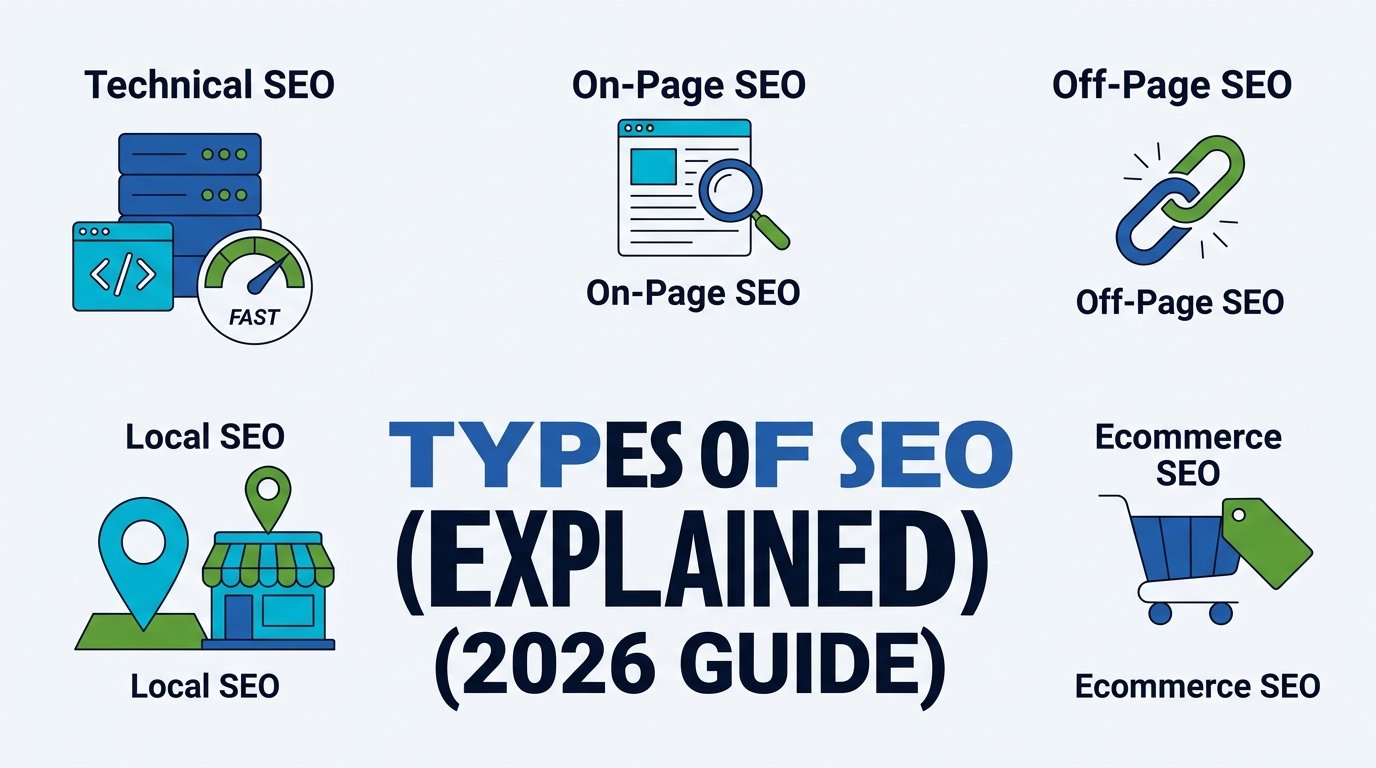
There are five main types of SEO: technical SEO (site infrastructure and crawlability), on-page SEO (content and keyword relevance), off-page SEO (backlinks and external trust signals), local SEO (visibility for location-based searches), and ecommerce SEO (product and category page optimisation). A newer category — AEO/GEO, optimising for AI-generated answers — is increasingly treated as a distinct discipline alongside the traditional five.
Why SEO Gets Split Into Types at All
SEO isn't one isolated activity — it's an ecosystem of interconnected disciplines that share the same ultimate objective: getting discovered by commercial buyers in search engines and AI assistants.
A website can excel in one dimension while failing catastrophically in another. A beautifully written, authoritative article (stellar on-page SEO) hosted on a server that takes eight seconds to load (broken technical SEO) will consistently fail to rank. Search engines and AI crawlers evaluate all dimensions holistically.
Technical SEO
Technical SEO covers the backend website architecture that determines whether search engines can crawl, render, index, and understand your pages.
- Server response speed (TTFB) and Core Web Vitals (LCP, INP, CLS)
- Mobile-friendly responsive code and touch targets
- Crawlability — XML sitemaps, robots.txt directives, indexation controls
- JSON-LD structured data (Schema.org) for rich snippets
- Logical internal site architecture and canonicalization tags
Why it matters: A website with world-class content but broken technical infrastructure — like accidental noindex tags or sluggish server response — will remain completely invisible. Technical SEO is the foundation upon which all organic rankings sit.
On-Page SEO
On-page SEO covers everything on an individual page that communicates its relevance and depth to a user's search query.
- Targeted title tags and compelling meta descriptions
- Hierarchical heading structure (H1 single topic, H2/H3 logical sub-topics)
- Topical authority, search intent matching, and semantic keyword integration
- Internal contextual links pointing to relevant service and pillar pages
- Descriptive image ALT tags and semantic HTML5 markup
Why it matters: On-page SEO tells search engines — and increasingly, LLM extractors — precisely what question your content answers. It is the most directly controllable SEO discipline.
Off-Page SEO
Off-page SEO covers external trust signals earned outside your website — primarily backlinks, brand mentions, and third-party authority validation.
- High-authority backlinks from credible industry publications
- Digital PR coverage and editorial features
- Unlinked and linked brand entity co-occurrences
- Consistent directory listings and local citations
Why it matters: Off-page SEO is the internet vouching for your domain's credibility. Without external authority, competing for high-value commercial terms is almost impossible.
Local SEO
Local SEO is optimization specifically engineered for location-based search intent — "near me" searches, "[service] in [city]," and the high-converting Google Maps 3-Pack.
- Google Business Profile (GBP) primary/secondary category optimization
- Local citation consistency (NAP: Name, Address, Phone number)
- Hyper-local service area landing pages (Geo-silos)
- Review velocity, review response management, and client photo uploads
- Local community backlinks from chambers of commerce and local press
Why it matters: Local SEO runs on a distinct algorithm from national search — proximity, review density, and profile completeness outweigh raw domain rating. A brand ranking #1 nationally can easily be invisible in its own local neighborhood without dedicated local SEO.
Ecommerce SEO
Ecommerce SEO focuses specifically on optimizing online retail stores with extensive product catalogs and multi-level category taxonomies.
- Product schema markup (price, availability, SKU, aggregateRating)
- Category hierarchy and faceted navigation canonical management
- Handling out-of-stock and discontinued inventory without losing rank equity
- Preventing thin and duplicate content across product color/size variations
Why it matters: Ecommerce websites face technical complexities — infinite URL permutations from filter combinations — that general content sites never encounter.
The Newest Addition: AEO and GEO
Two modern terms have entered the search lexicon to address the rise of conversational AI engines:
AEO (Answer Engine Optimisation)
Optimizing content specifically to win Featured Snippets, "People Also Ask" dropdowns, and voice search responses — positioning concise, factual direct answers directly above standard organic links.
GEO (Generative Engine Optimisation)
Optimizing your brand entity, citations, and content to be cited and recommended directly inside generative AI answers from tools like ChatGPT, Gemini, Perplexity, and Google AI Overviews (explore Digital4Local's GEO/AEO service).
Whether considered a sixth SEO type or a next-generation evolution, AEO and GEO rely on the same fundamental building blocks: clean technical schema and structured, authoritative content.
Quick Comparison: The Types of SEO
| SEO Type | Primary Focus | Main Ranking Surface |
|---|---|---|
| Technical SEO | Site infrastructure, speed & crawlability | All search engines & AI crawlers |
| On-Page SEO | Content quality, intent & keyword relevance | Standard organic search results |
| Off-Page SEO | Backlinks, digital PR & external authority | Competitive commercial queries |
| Local SEO | Location-based searches, Google Business Profile | Google Maps 3-Pack & mobile queries |
| Ecommerce SEO | Product pages, category taxonomies & faceted filters | Google Search & Google Shopping |
| AEO / GEO | Direct-answer formatting & entity citations | ChatGPT, Perplexity, Google AI Overviews |
Do You Need All Types of SEO?
Not equally, and rarely all at the same time. The optimal allocation depends on your specific business model:
Local Service Business (Plumber, Clinic, Installer)
Prioritise Local SEO, Technical SEO, and GEO. This is where 90%+ of your commercial inquiries originate.
Ecommerce Retail Store
Prioritise Ecommerce SEO and Technical SEO to ensure thousands of product pages rank without duplication.
B2B SaaS / Publisher
Prioritise On-Page SEO, Off-Page Authority, and AEO to capture high-intent informational and comparative queries (e.g. SEO vs SEM).
Every Modern Business
Must incorporate GEO/AEO to secure brand recommendations as search traffic migrates to AI assistants.
How the Types Interact — A Real Example
These five types are not isolated silos; weakness in one actively neutralizes strength in another.
Consider a local plumbing contractor with an exceptional service guide (strong on-page SEO). If the site takes 7 seconds to load on mobile (weak technical SEO) and has an incomplete Google Business Profile with no reviews (weak local SEO), the page will never appear in the Google Maps 3-Pack where nearby homeowners convert. Furthermore, high bounce rates caused by slow loading speeds will gradually depress its organic rankings.